Rumi, Coltrane, and Me
This is What It Sounds Like

Back in September, I received a mass invite in a school Whatsapp chat group to a K-Pop Demon Hunters birthday party - a perfect postcard from Parenthood 2025 if there ever was one. The invite winked at me through a detail hiding in plain sight: the party’s atypical location, a West Village dive bar called Cellar Dog that many of us parents patronized 20 years ago when it was called Fat Cat. Based on recent photos, the Dog still looked more or less like the Cat, which is more than we parents could say of ourselves.
The kids, dressed as characters from the movie, had a blast, wreaking havoc on shuffle board tables they could barely see over, as the parents, some also dressed in character, sipped on beer while swapping summer break stories and notes on the start of the school year. It was a great party for all ages, but when parents and kids joined voices to the chorus of Takedown, I just stared, clueless to what I was witnessing. As a household without TV or social media, I’m used to being out of the loop, having decided years ago that the gain in clarity is greater than the loss in cultural awareness. But in that windowless, underground space, with the music blasting and the movie projected against a wall, I had nowhere to hide. As my six year-old son and I left the party, I texted my wife, “We should watch K-Pop Demon Hunters.”
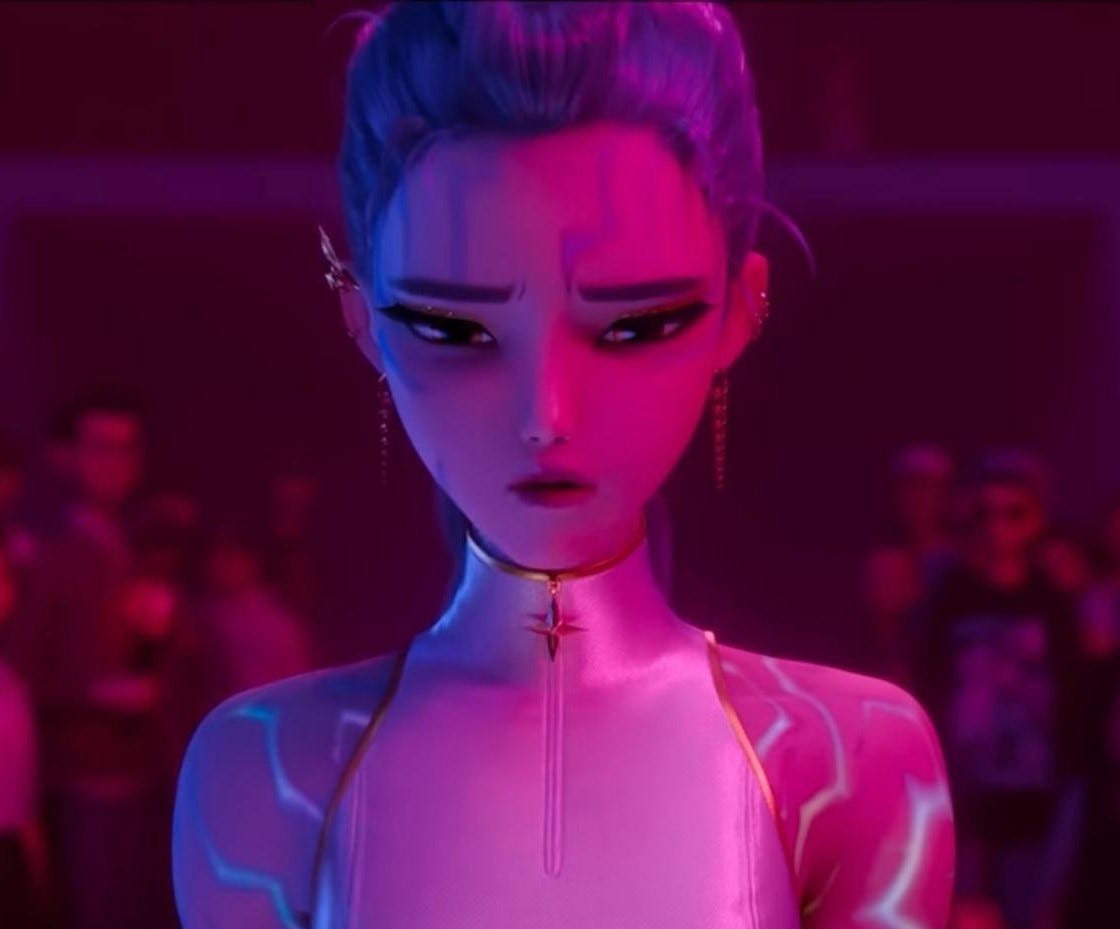
For those who haven’t seen it, K-Pop Demon Hunters is an animated movie about HUNTR/X, a K-Pop girl band and its three members Mira, Zoey, and Rumi, the leader of the group and the movie’s central character. Because I approached the film as a cultural catch-up assignment, I didn’t expect to be so immediately entertained by its smashmouth opening minutes, which set the tone with style, action, humor, music, and story.
I especially appreciate the story, which gives HUNTR/X a purpose to their K-Pop as the modern day torch bearers of a centuries-old lineage that wields music as a positive spiritual force to protect humanity from demons.
The demons’ own lineage stretches back just as far. They are represented by HUNTR/X’s rivals, the Saja Boys, a boy band whose smooth dance moves, six-pack abs, and silky voices conceal the destructive message of their catchy lyrics: you are not enough. They don’t just want to win fans away from HUNTR/X; they want to take souls.
I’m definitely a kids-what’s-the-moral-of-the-story kind of guy, so I love that K-Pop Demon Hunters wrestles with self-worth, regret, redemption, and other weighty themes. Yet my heart hurt for the HUNTR/X girls themselves, not when they stared down demons, but whenever they checked social media for the ultimate measure of their impact on the world, the scoreboard in their battle with The Saja Boys.
Does part of me wish they were social media-free like me? Ultimately no, because that’s not the way you become Netflix’s all-time most-watched. But on the important stuff, we are very much aligned. We’re all hunting demons to protect others, just in different ways. For Mira, Zoey, and Rumi, this means literally fighting demons and performing as HUNTR/X to strengthen the ancient spiritual force field, the honmoon.
For me, protecting others from demons focuses primarily on my kids. Although it doesn’t require hand-to-hand combat, it is a good-vs-evil conflict on a spiritual battlefield, so I teach and show them the closest thing to the honmoon that I know: God’s unconditional love.
[A]t my core, I desire to be great by doing great things. With that desire, there is no rest and the hardest thing is letting go.
At least that’s what I try to do, but I am far, far from perfect. The challenge starts with my own difficulties receiving unconditional love, which is one of those things that’s so easy, it’s hard. Drink more water. Go to bed earlier. Call you parents more often. I struggle to improve on these simple things because at my core, I desire to be great by doing great things. With that desire, there is no rest and the hardest thing is letting go.
The issue, I think, is not greatness itself but the false hope that achieved greatness can make us feel whole. Rumi’s story is a vivid example. As the leader of HUNTR/X, she is everything we imagine modern greatness to be. But the driving force in her life is shame, and so she strives in order to hide her demon heritage. The anthem of this look-at-me-now ethos is Golden where Rumi sings, “I’m done hiding. Now I’m shining,” but the words crack in her voice because the truth is, she cannot outshine her shame.
Only when she lets go of trying to save herself does she find herself. “Nothing but the truth now / Nothing but the proof of what I am,” she sings in This is What It Sounds Like, “I tried to fix it, I tried to fight it / … / I broke into a million pieces, and I can’t go back / But now I’m seeing all the beauty in the broken glass.”
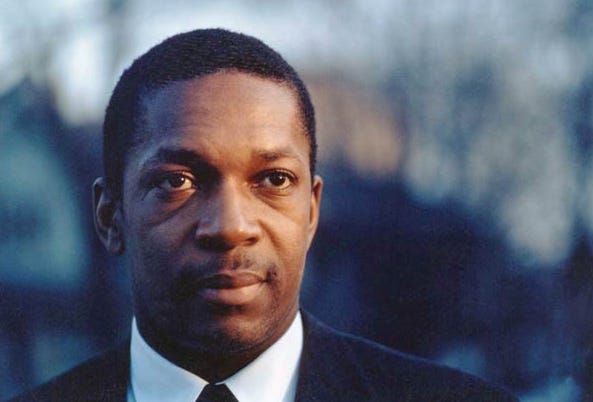
As an animated movie made for kids, it’s tempting to dismiss K-Pop Demon Hunters and Rumi’s story. But before you do, consider the saxophonist John Coltrane. In the first half of his career, Coltrane is an undeniable talent in Miles Davis’ quintet. “Trane was the loudest, fastest saxophonist I ever heard,” wrote Davis, “He could play real fast and real loud at the same time - and that’s incredibly difficult to do … but Trane could do it. He was phenomenal. It was like he was possessed when he put that horn in his mouth.” This was Coltrane in the first half of his career - a dominant force that redefined what was possible on the sax.
But it came to an end in 1957 when Davis dismissed Coltrane because of his heroin addiction. Shortly after, Coltrane went through a physically excruciating but ultimately successful withdrawal from heroin. He reflects on this period - the beginning of the second half of his career - in the liner notes of his most celebrated album, A Love Supreme: “During the year 1957, I experienced, by the grace of God, a spiritual awakening which was to lead me to a richer, fuller, more productive life. At that time, in gratitude, I humbly asked to be given the means and privilege to make others happy through music. I feel this has been granted through His grace. ALL PRAISE TO GOD.”
It’s a paradox, that our deepest desires elude our grasp when we try too desperately to grasp them; that to behold majesty is far greater than any tenuous mastery we might achieve
Like Rumi’s personal triumph, Coltrane’s spiritual awakening is a testimony to “letting go,” an example of what it’s like when personal perfection and dominance have been replaced by grace, service to others, and, of course, love. The hands, once clenched in fists of self-determination, are now open, ready to receive and serve; drivenness for personal greatness is now devotion to something greater. It’s a paradox, that our deepest desires elude our grasp when we try too desperately to grasp them; that to behold majesty is far greater than any tenuous mastery we might achieve; and yet we understand this intuitively because it is woven into the fabric of life, invisible and fundamental to our made-in-the-image-of-God experience.
I can honestly tell you that this is not the essay I thought I’d be writing. I started this as a commentary on K-Pop Demon Hunters’ crossover into real life, and my plan was to express concern for the story’s deeper message being overshadowed by the movie’s modern aesthetics. But having recently read Stephen King’s memoir, On Writing, I applied his advice to write as though chipping away at the dirt to reveal a fossil, and this is the essay I discovered. Just like when I watched K-Pop Demon Hunters for the first time, I’m pleasantly surprised. I hope you are, too.
Unconditional love man, big topic for us dudes.
Just finished Bird by Bird recently, if you haven’t read that check it out. I liked it more than King’s book.